As a hiring manager, you are an expert in risk mitigation. You meticulously screen resumes, conduct multi-stage interviews, perform skills assessments, and check references. You measure everything that can be measured. But what if your biggest risk is completely invisible to these tools? What if the factor most likely to cause a new hire to fail is something that never appears on a resume?
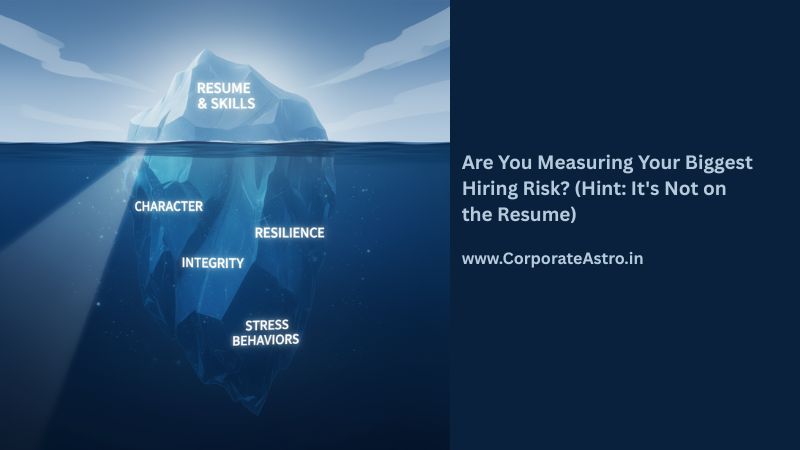
Think of a candidate like an iceberg. The 10 percent that is visible above the water is their resume: their skills, their experience, their education. This is the part we all focus on. The 90 percent that is hidden below the surface, however, is far more powerful and dangerous. This is their character, their core temperament, their resilience under pressure, their innate integrity, and their default communication style. This is your biggest hiring risk.
Why Standard Tools Cannot See Below the Surface
The entire recruitment industry is built to assess the visible 10 percent. While essential, this creates a dangerous blind spot. A candidate can have the perfect resume but possess a fundamental character flaw or behavioral tendency that will inevitably cause friction, disengage their team, or lead to failure in a high-pressure situation. These are the risks that lead to costly mis-hires.
Your interview process, no matter how rigorous, is designed to evaluate a performance. It cannot reliably measure a person's core nature. That is because you are assessing a practiced persona, not the real person.
"Hiring based on a resume is like navigating an iceberg field by only looking above the water. It is not a matter of if you will hit something, but when."
The Sonar You Need to Measure What Matters
To truly de-risk your hiring process, you need a tool that can see below the surface. This is the role of Vedic Analytics. It acts like a sonar system, sending out a signal to map the 90 percent of the iceberg that is normally hidden from view. By analyzing the objective and unchangeable data of a candidate's Vedic birth chart, we can measure the intangible traits that are the true predictors of long-term success.
- Measure True Resilience: The chart reveals an individual's innate emotional and mental fortitude. You can see if they are naturally built to withstand pressure or if they are prone to reactivity.
- Assess Core Integrity: Planetary placements can indicate a person's deep-seated sense of ethics and discipline, providing a crucial check on character that goes beyond references.
- Decode Communication DNA: You can understand a candidate's default communication style. Are they naturally diplomatic, direct, analytical, or empathetic? This ensures they are a fit for the role and the team they will be joining.
By adding this layer of deep, objective data to your process, you stop gambling on the hidden ninety percent. You can finally measure the risks that matter most, ensuring your next hire is not just skilled on paper, but is also a resilient, high-integrity individual built for long-term success.
Frequently Asked Questions
The biggest risk is a fundamental mismatch between a candidate's core nature and the demands of the role, especially concerning their integrity, resilience under pressure, and their innate collaboration style. These traits, not their listed skills, are the primary drivers of long-term success or failure.
Vedic analytics uses the objective, unchangeable data of a birth chart, which acts as a personality blueprint. The planetary placements provide a consistent and ancient framework to analyze innate traits, removing the subjectivity and potential for bias found in interviews and self-assessments.
No, it is designed as a quick and efficient final validation step for shortlisted candidates. It provides critical, high-level data in a timely manner to confirm a high-stakes decision without creating bottlenecks in the recruitment pipeline.